

When we talk about the “big stuff” in the Sea of Cortez, the conversation naturally drifts toward whales, sea lions, and sharks. But there is another group of animals that brings a profound sense of grace and magic to our waters: the rays.
Closely related to sharks, these cartilaginous fish have flattened bodies and expanded pectoral fins that look—and function—just like wings. While they share a common ancestry, the rays you will see diving in San Carlos are divided into two very different lifestyles: the pelagic “flyers” that soar through the water column, and the benthic “bottom-dwellers” that master the art of camouflage.
Keep your eyes on the blue and your gaze on the sand. Here is your diver’s guide to the rays of the Sea of Cortez.
The Pelagic Flyers: Soaring in the Blue
These are the filter-feeders and open-ocean cruisers. You’ll usually spot them mid-water, particularly on boat dives out to Isla San Pedro Nalasco or the offshore seamounts.
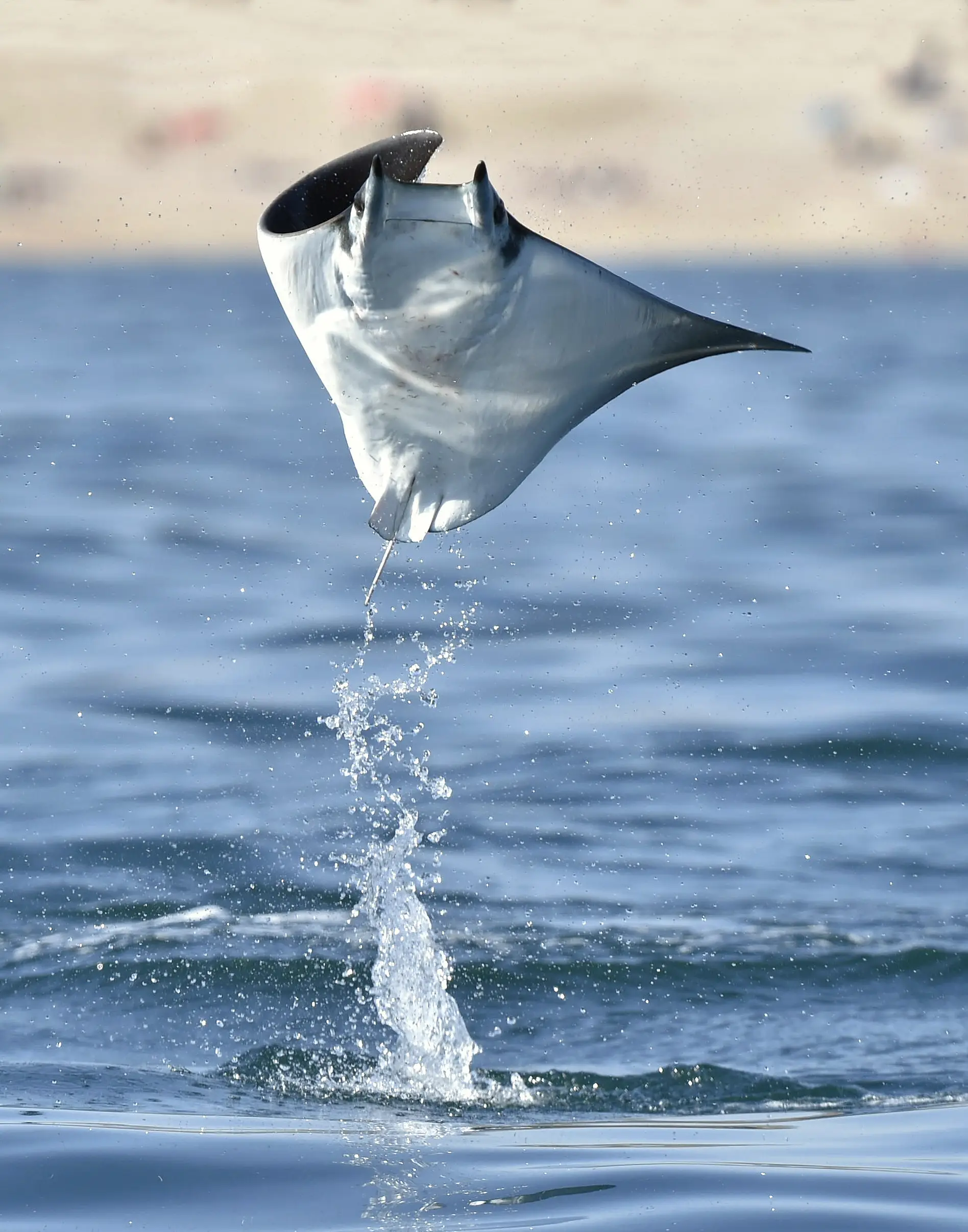
The Acrobats: Mobula Rays
If you see a ray soaring through the blue in San Carlos, there is a very high chance it is a Mobula. While Munk’s Devil Ray (Mobula munkiana) is the most famous for its massive aggregations, the Sea of Cortez is actually home to several species of devil rays (including Thurston’s and the Chilean devil ray). These are the undisputed acrobats of the Gulf. They look like miniature manta rays, with cephalic fins (the “horns” on their faces) used to funnel plankton into their mouths.
The Encounter: Mobulas are famous for their schooling behavior. During the warmer months or when plankton is rich, they gather in massive squadrons, sometimes numbering in the hundreds or thousands. Seeing a “fever” of Mobulas glide silently past you in the blue water is a breathtaking experience. Topside, you might even see them breaching—launching themselves several feet into the air and belly-flopping back into the sea with a loud smack!
The Gentle Giants: Giant Oceanic Manta Rays
While the gigantic Oceanic Manta Ray (Mobula birostris) is more famously associated with the Revillagigedo Archipelago (Socorro), these magnificent, 20-foot-wide behemoths do occasionally cruise the deeper channels of the Sea of Cortez. They are rare visitors to our local reefs, but encountering one of these gentle filter-feeders casting a massive shadow over the dive site is the ultimate scuba diving lottery ticket.
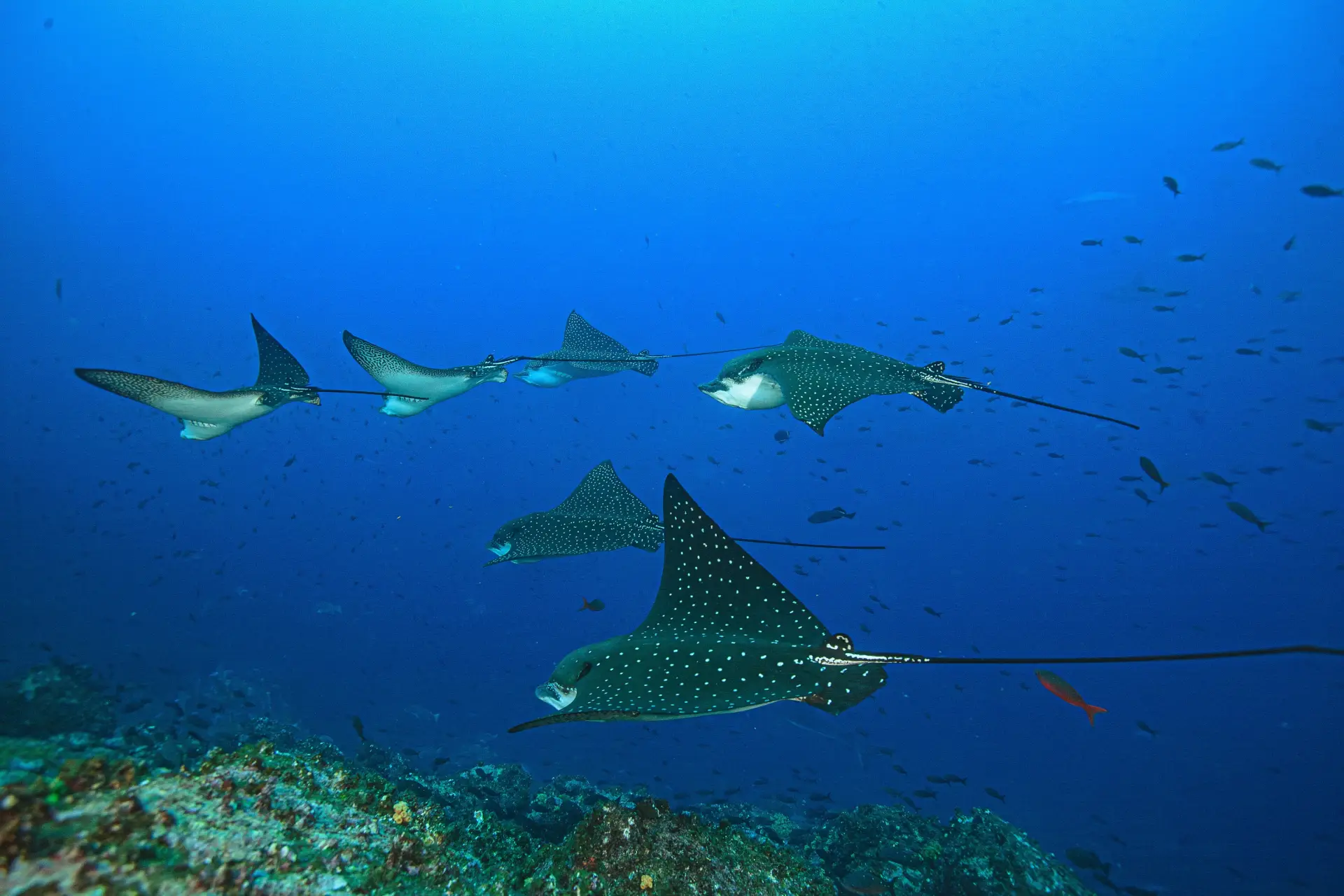
The Elegant Gliders: Spotted Eagle Rays
Easily identified by their dark dorsal surface covered in distinct white spots and rings, the Spotted Eagle Ray (Aetobatus narinari) is a breathtaking sight. They have a pronounced, beak-like snout and a long, whip-like tail. You will often see them cruising gracefully along the reef edges or swimming out in the blue, sometimes alone and sometimes in small groups.
The Schooling Migrators: Pacific Cownose Rays
The Pacific Cownose Ray (Rhinoptera steindachneri) gets its name from its uniquely indented, double-lobed snout that resembles a cow’s nose. These rays are highly migratory and are famous for traveling in massive, synchronized schools. Spotting a large fever of golden-brown cownose rays gliding overhead is a mesmerizing experience.
The Benthic Bottom-Dwellers: Masters of the Sand
Not all rays want to fly. Many species spend their lives on the sandy bottoms between our volcanic rock formations, hunting for crustaceans and mollusks.
The Diamond Stingray and Round Stingray
These are the absolute masters of camouflage. Both the large Diamond Stingray and the smaller Round Stingray will bury themselves completely in the sand, leaving only their eyes and spiracles (breathing holes) exposed. They are very common at shore dive sites like Window Rock and San Antonio Point.
Diver Safety Tip: These rays possess a venomous barb on their tail, but they are entirely non-aggressive. A sting only happens defensively if they are stepped on or directly threatened. This is why we always preach good buoyancy! For shore entries, remember to do the “Stingray Shuffle”—slide your feet through the sand rather than taking big steps to warn them you are coming so they can safely swim away.
The Cortez Electric Ray
Also known as the Giant Electric Ray, this is one of the most fascinating animals on the reef. They are usually dark gray or brown with darker spots, and they look slightly thicker and “mushier” than a typical stingray.
The Superpower: As their name implies, they have specialized kidney-shaped organs on either side of their head that can generate an electric shock of up to 45 volts! They use this to stun their prey (small fish and worms) and deter predators. While a shock won’t seriously injure a human, it is an incredibly unpleasant jolt that you will feel all the way up your arm. It is the ultimate reminder to practice the “Look, Don’t Touch” rule of scuba diving.
The Bat Ray
You can easily identify a Bat Ray by its distinct, protruding, blocky head (which looks almost like a blunt pig’s snout) and dark brown or black coloring. Unlike the stingrays that glide smoothly over the bottom, Bat Rays swim by flapping their pectoral fins exactly like a bird in flight. They use their strong jaws to crush clams and crabs, often leaving small, crater-like ‘feeding pits’ in the sand.
The Evolutionary Link: Shovelnose Guitarfish and Skates
As you scan the sand, you might spot something that looks like a cross between a shark and a ray. The Shovelnose Guitarfish has a flattened, spade-shaped head and a thick, shark-like tail. Along with various species of skates (like the Big Skate), these bottom-dwellers prefer the sandy flats and are excellent at burying themselves, leaving only their eyes exposed as they wait for passing crustaceans.
How to Spot Them Without Disturbing Them
The key to diving with rays, particularly the bottom-dwellers, is mastering your position in the water column. If you swim too close to the bottom with a flutter kick, the downward thrust of your fins will kick up a massive cloud of sand (silting), blinding your buddy and scaring away any buried rays.
This is exactly why we highly recommend the SSI Perfect Buoyancy specialty. Learning to master the “frog kick” allows you to propel yourself forward without pushing water downward. You can hover inches above the sand flats, spot the outline of a buried Diamond Stingray, and observe it peacefully without ever disturbing its rest.
Ready to earn your wings? Book your next dive trip to San Carlos and let our expert guides point out the magnificent rays of the Sea of Cortez!