

 For the vast majority of divers who visit Isla San Pedro Nalasco, the action is on the surface and in the shallows. They come for the “puppy pile” of sea lions barking and cartwheeling in 15 to 30 feet of water. It is a chaotic, joyful, and noisy experience. But for a select group of divers, there is a different kind of magic waiting here. It is found by swimming away from the noise, over the rocky ridge, and descending into the silent, cobalt blue.
The island is a submerged mountain, and while the sea lions claim the peaks, the true majesty of its geology reveals itself in the depths. To see it safely, you need to go beyond the limits of recreational open water diving. This is why the Deep Diver Specialty is the key to unlocking the “other” Isla San Pedro Nalasco.
The Limits: Why 60 Feet Isn’t Enough
As an Open Water Diver, you are trained to 60 feet (18 meters). As an Advanced Open Water Diver, your limit extends to 100 feet (30 meters). But the underwater topography of the Sea of Cortez is dramatic and vertical. Often, the most spectacular features—the true base of the wall, the cleaning stations for larger animals, and the specific habitats for rare corals—start right where your Advanced certification ends.
The Deep Diver Specialty trains you to safely execute no-decompression dives to the recreational limit of 130 feet (40 meters). That extra 30 feet might not sound like much on paper, but underwater, it opens up a completely new ecological zone.
What Awaits Below the Ledge?
So, why drop down? Here is what you gain access to when you extend your range at the island:
1. The Black Coral Forests
In the shallow water, the reef is dominated by hard corals and rocky substrate. But as you descend past 100 feet, the landscape changes. This is the domain of the Black Coral (Antipathes). Despite the name, living black coral bushes are often a brilliant yellow, orange, or white. At depth, they grow into massive, tree-like forests that jut out from the vertical walls. These structures are fragile, ancient, and strikingly beautiful, creating a habitat for unique deep-water shrimp and longnose hawkfish that you simply won’t find in the shallows.
 2. The Pelagic Highway
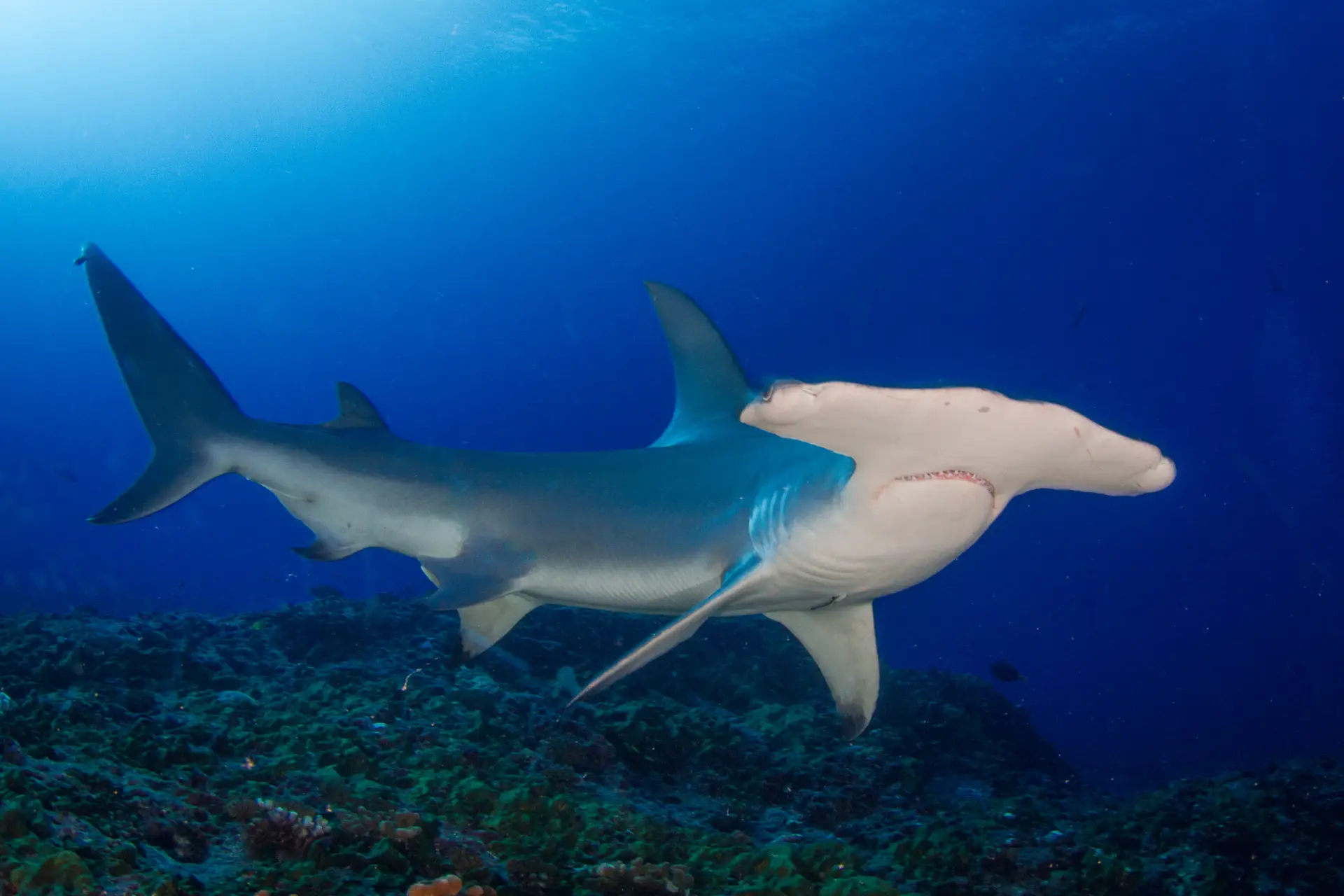
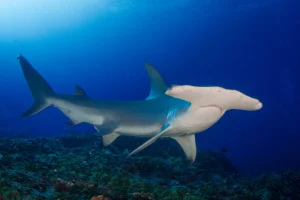
Big animals like deep water. While you can certainly see Mobulas near the surface, the larger pelagics often patrol the deeper edges of the island where the currents strike the walls. Descending to 100+ feet puts you closer to the “blue window.” This is the realm where you are more likely to spot a solitary hammerhead shark cruising in the distance, a school of large tuna, or massive groupers lurking in the shadows of the deep boulders.
3. The Vertigo of the Wall
There is a specific thrill that comes from hovering at 120 feet next to a vertical rock face that plunges down into the darkness. It gives you a true sense of the island’s scale. Looking up, you can see the silhouette of the sea lions playing in the sun-drenched surface far above, while you float in the silent, twilight world below. It is a perspective few divers get to experience.
What You Will Learn
Going deep requires discipline. It is not just about swimming down; it’s about managing risk. The Deep Diver course conducted at the island will teach you:
- Gas Management: You consume air much faster at 4 atmospheres of pressure. You will learn strictly conservative gas planning rules to ensure you always have enough to return safely.
- Narcosis Management: “The Martini Effect” is real. You will learn to recognize your own symptoms of nitrogen narcosis and how to handle them calmly.
- Redundant Air Sources: We introduce you to the use of pony bottles or drop tanks, adding a layer of safety essential for deep exploration.
The shallows of San Carlos are fun, but the depths are awe-inspiring. If you are ready to leave the noise behind and explore the dramatic verticality of the Sea of Cortez, it’s time to get trained.
Ready to go beyond the ledge? Contact us to schedule your Deep Diver Specialty course and see the island like few others do.