
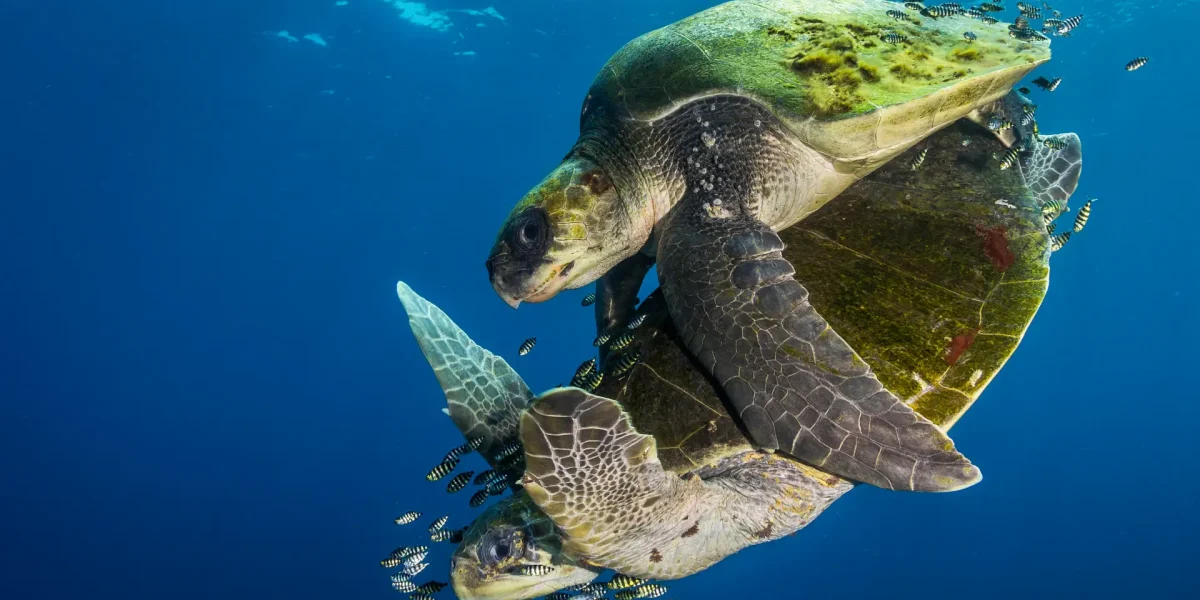
There is a universal rule in scuba diving: no matter how many times you see a sea turtle, you will always stop, breathe a little slower, and watch them glide by. They are the ancient mariners of the reef, possessing a calm, effortless grace that mesmerizes divers of all experience levels.
Jacques Cousteau famously called the Sea of Cortez the “World’s Aquarium,” and its rich, protected waters serve as a critical foraging and breeding ground for these endangered reptiles. In fact, five of the world’s seven sea turtle species can be found navigating the Gulf of California. Here is your guide to identifying the magnificent turtles you might encounter while diving in San Carlos.
1. The East Pacific Green Turtle (The “Black” Turtle)

If you spot a turtle lazily resting under a rocky ledge at Window Rock or Isla San Pedro Nalasco, it is most likely a Green Sea Turtle (Chelonia mydas). Interestingly, the local sub-population here is often referred to as the Black Sea Turtle (Tortuga Prieta) because their carapaces (shells) are noticeably darker—ranging from dark gray to almost black—compared to Green turtles in the Caribbean.
They are the herbivores of the turtle world. While juveniles will eat jellyfish and small invertebrates, adults transition to a diet almost exclusively of seagrass and algae. You will often see them scraping algae right off the volcanic rocks.
2. The Hawksbill Sea Turtle

The Hawksbill (Eretmochelys imbricata) is arguably the most beautiful of all sea turtles, famous for its stunning, overlapping scutes that make up a tortoiseshell pattern. Unfortunately, this beauty made them a target for poachers for decades, making them critically endangered today.
You can easily identify a Hawksbill by its narrow, pointed beak (which looks exactly like a hawk’s bill). This specialized mouth isn’t for eating plants; it’s a precision tool used to extract their favorite food—sponges—from tight crevices in the reef. If you see a turtle actively rooting around in the nooks and crannies of the SAAS wrecks, check the beak!
3. The Loggerhead Sea Turtle
The Loggerhead (Caretta caretta) is the bruiser of the bunch. They are named for their exceptionally large heads and massive, muscular jaws. They need those powerful jaws because they are carnivores with a taste for hard-shelled prey like crabs, conchs, and sea urchins.
The Loggerheads found in the Sea of Cortez have one of the most incredible migrations on the planet. Many of them are born on the beaches of Japan, swim entirely across the Pacific Ocean to feast in the nutrient-rich waters of Baja California and Sonora for several years, and then swim all the way back to Japan to mate!
4. The Olive Ridley Sea Turtle

The Olive Ridley (Lepidochelys olivacea) is the smallest of the sea turtles found in the region, usually weighing less than 100 pounds. They get their name from the olive-green hue of their heart-shaped shell.
While they do forage in the Gulf of California, they are most famous for their nesting behavior. Rather than nesting alone, Olive Ridleys gather by the thousands in synchronized mass-nesting events called arribadas (arrivals). While the largest of these take place further south in Mexico and Costa Rica, seeing a solitary Olive Ridley cruising the open water in Sonora is a special treat.
5. The Leatherback Sea Turtle

Encountering a Leatherback (Dermochelys coriacea) is like seeing a living dinosaur. They are the largest turtles on Earth, capable of reaching 7 feet in length and weighing over 1,500 pounds!
Unlike the other four species, Leatherbacks do not have a hard, bony carapace. Instead, their backs are covered in a thick, leathery, ink-blue skin with seven distinct ridges running down the length of their bodies. They are pelagic wanderers that rarely come near the shallow reefs. They dive to incredible depths (over 4,000 feet) to hunt their exclusive prey: jellyfish. Spotting one of these giants from the dive boat is a rare and unforgettable experience.
Diver Etiquette: How to Interact with Sea Turtles
Because all species of sea turtles are threatened or endangered, it is our responsibility to be passive, respectful observers. When you encounter a turtle underwater, remember these golden rules:
- Never touch, ride, or chase a turtle. This causes immense stress and can prompt them to bolt, burning precious energy they need to survive.
- Give them a clear path to the surface. Turtles are reptiles and need to breathe air. Never hover directly above a turtle, as you might block them from taking a breath.
- Watch your buoyancy. Hover quietly and let the turtle dictate the interaction. Perfecting your SSI Perfect Buoyancy skills ensures you don’t crash into the reef or kick up sand while admiring them.
Want to learn more about these incredible ancient mariners? Book your next dive with us to see them in the wild!