

If you were to cast a villain for a scuba diving movie, the moray eel would get the part immediately. They slither through dark crevices like snakes, they have beady eyes, and they spend the entire dive staring at you with their mouths wide open, displaying rows of razor-sharp teeth.
But looks can be deceiving. The moray eel is one of the most misunderstood residents of the Sea of Cortez. They are not aggressive monsters lying in wait to attack divers; they are shy, highly specialized predators with some of the most fascinating anatomy in the animal kingdom. Here is everything you need to know about the moray eels hiding in the rocky reefs of San Carlos.
Why Are They Always “Panting”?
The most common question new divers ask about morays is, “Why do they look like they are about to bite me?”
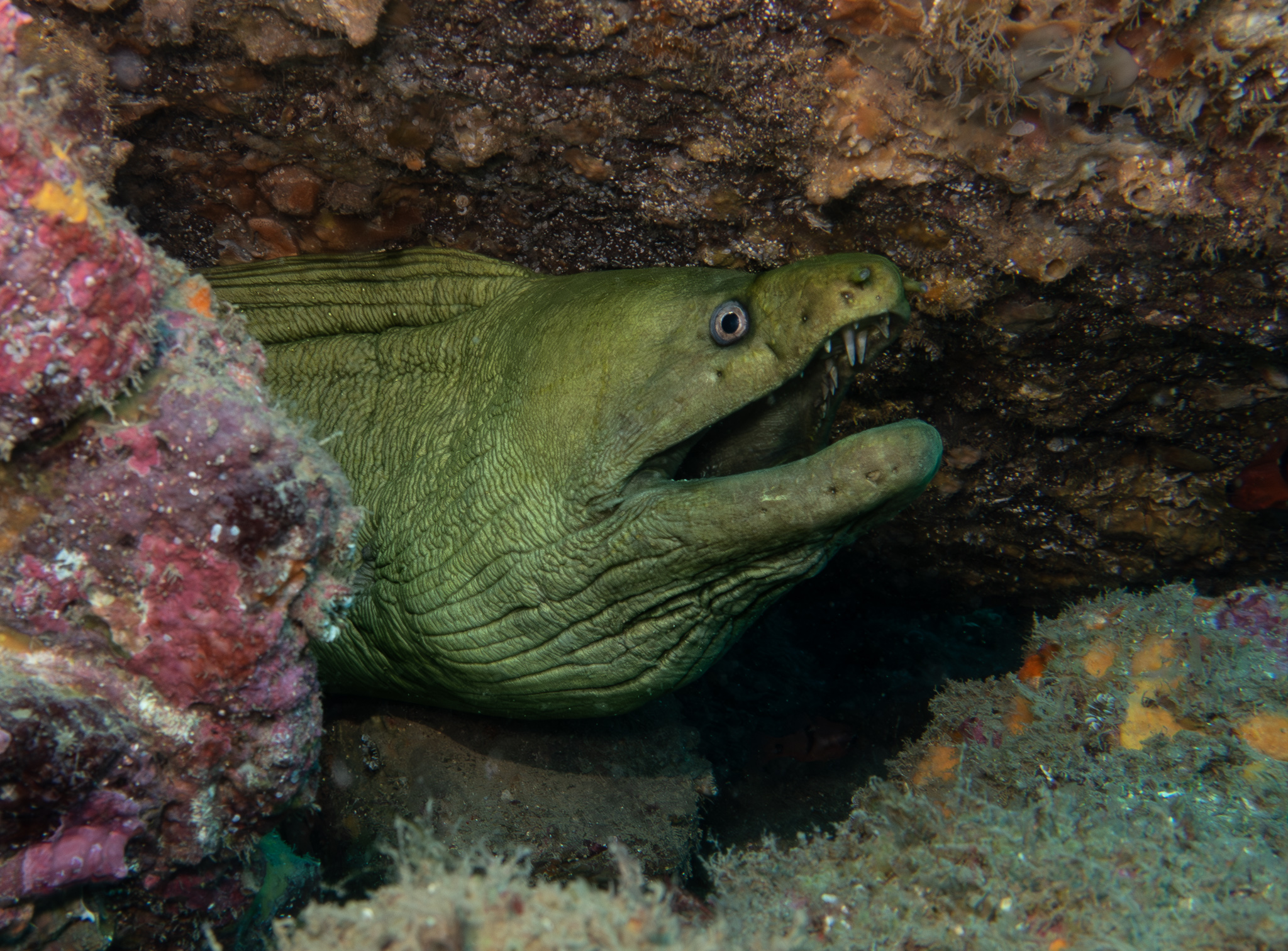
That gaping mouth isn’t a threat display; it’s simply how they breathe. Unlike most fish that have bony gill covers to pump water over their gills, moray eels have small, circular gill openings. To move oxygen-rich water over these gills, they have to constantly open and close their mouths, forcing the water back through their respiratory system. They aren’t snapping at you; they are just taking a breath!
The “Alien” Anatomy: The Pharyngeal Jaw
If you’ve seen the sci-fi movie Alien, you are familiar with the concept of a creature having a second set of jaws hidden inside its throat. Believe it or not, moray eels actually have this!
Because morays live in tight crevices, they can’t open their mouths wide enough to swallow prey whole like a grouper does, and they don’t have limbs to help push food down. Instead, they use a pharyngeal jaw. When a moray bites down on a fish or octopus with its primary teeth, a second set of jaws located deep in its throat launches forward, grabs the prey, and pulls it down into the esophagus. They are the only known vertebrate to hunt using this incredible mechanism.
The Locals: Moray Species of San Carlos
The volcanic rocks and boulders of San Carlos provide the perfect habitat for several species of morays. Here are the ones you are most likely to encounter:
The Panamic Green Moray
This is the undisputed king of the crevices. The Panamic Green Moray is massive, capable of growing over six feet long with a body as thick as a diver’s thigh. Despite their name, they are actually brown; the “green” color comes from a thick, yellowish mucus that covers their skin to protect them from parasites and scrapes against the sharp volcanic rocks. Finding one of these giants tucked under a ledge at Isla San Pedro Nalasco is a humbling experience.
The Jewel Moray
Much smaller and incredibly beautiful, the Jewel Moray is a favorite among underwater photographers. They are dark brown or black, covered in brilliant white or yellow spots (the “jewels”). They are very common at shallow shore dive sites like Window Rock and San Antonio Point.
The Zebra Moray
A completely different looking eel, the Zebra Moray has bold black and white stripes and a blunt, rounded snout. Unlike the sharp teeth of the Green Moray designed for catching slippery fish, the Zebra Moray has flat, pebble-like teeth. They use these to crush the shells of their favorite foods: crabs, shrimp, and sea urchins.
The Cleaning Stations
Morays are often the centerpieces of reef “cleaning stations.” If you look closely at a resting moray, you will frequently see tiny, transparent cleaner shrimp or small wrasses picking at their skin and even swimming inside the eel’s mouth. This is a classic symbiotic relationship: the eel gets a free cleaning to remove dead skin and parasites, and the shrimp gets a free meal. The eel instinctively knows not to eat its hygienist!
Diver Etiquette: How to Dive with Eels
Moray eels are incredibly safe to be around, provided you follow a few basic rules:
- Keep Your Hands to Yourself: The only time a moray bites a diver is when the diver makes the mistake of sticking their hand into a dark hole. Eels have poor eyesight and hunt by smell. If you wave pink, sausage-shaped fingers in their face, they might mistake you for an octopus.
- Watch Your Buoyancy: To get a good look at an eel, you need to be able to hover motionlessly. Crashing onto the reef will send the eel retreating deep into its hole. Perfecting your SSI Perfect Buoyancy skills is the best way to get close to these animals without disturbing them.
- Try a Night Dive: By day, morays are mostly just heads poking out of holes. By night, they are free-swimming apex predators. A night dive in San Carlos is the absolute best way to see the full, snake-like body of a moray eel as it hunts across the open reef.
The moray eel is a testament to the incredible adaptations of marine life. The next time you see that gaping mouth and those sharp teeth, don’t swim away in fear. Hover, observe, and appreciate one of the most remarkable predators in the Sea of Cortez.
Want to see a free-swimming moray hunt? Contact us to book an SSI Night Diving and Limited Visibility specialty course and experience the reef after dark!