

If you’ve spent much time diving in the Caribbean or the tropical South Pacific, you’ve likely been told one thing very clearly: “Don’t wear gloves.” In many of those destinations, gloves are actively discouraged or even banned to prevent divers from touching and damaging delicate coral reefs. It’s a policy rooted in conservation, and in a sandy, coral-heavy environment, it makes perfect sense.
But then you arrive in San Carlos. You look at the local guides, the seasoned regulars, and the technical divers, and you notice something: everyone is wearing gloves.
The Sea of Cortez is a different kind of animal. It is not a soft, sandy tropical paradise; it is a rugged, volcanic, and “spiny” environment. In San Carlos, wearing gloves isn’t about giving yourself permission to grab the reef—it’s about safety, thermal protection, and injury prevention. Here is why you should always include a pair of dive gloves in your suitcase when visiting San Carlos.
 The Volcanic Landscape: Nature’s Razor
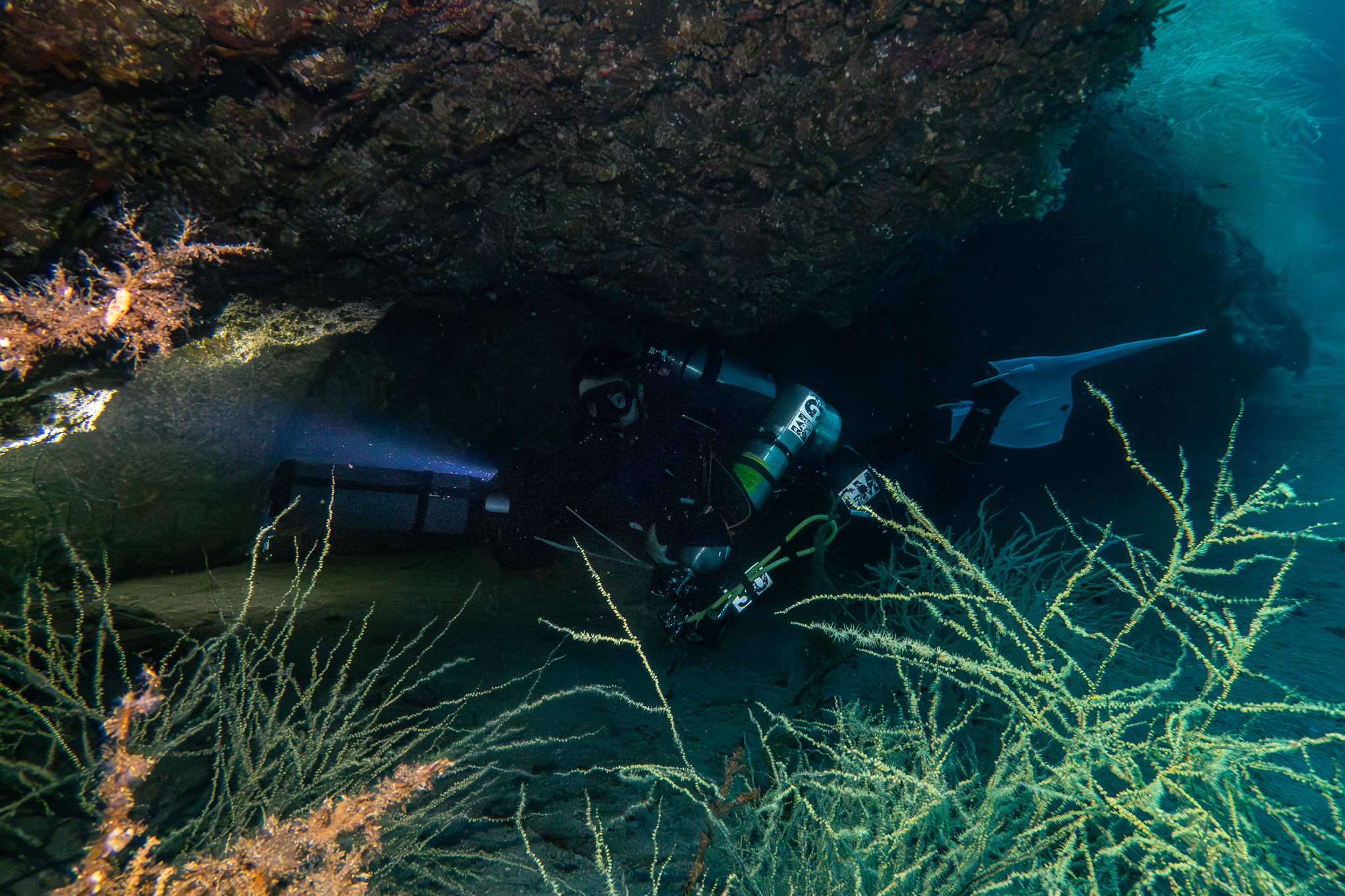
The stunning underwater topography of San Carlos is defined by its volcanic origins. The reefs aren’t made of soft limestone; they are composed of jagged basalt, rhyolite, and hardened volcanic ash. These rocks are incredibly porous and often feature edges that are as sharp as a steak knife.
Even the most experienced diver with perfect buoyancy can find themselves in a situation where a surge or a sudden current pushes them toward a rock face. In the Caribbean, you might get a scrape; in the Sea of Cortez, an unprotected hand brushing against a volcanic ledge can result in a deep, painful laceration. Gloves act as a vital sacrificial layer between your skin and the “razor” of the reef.
The Barnacle Factor
If the rocks weren’t sharp enough on their own, they are almost entirely covered in barnacles. These small, crusty organisms might look harmless from a distance, but they are essentially tiny volcanoes made of calcium carbonate. Their edges are razor-sharp.
Whether you are shore diving at Window Rock and navigating the entry, or performing a safety stop near a buoy line that has been in the water for a few months, barnacles are everywhere. One accidental slip or a firm grip on a descent line covered in growth can result in dozens of tiny “paper cuts” that sting in the salt water and take weeks to heal. A 1.5mm or 3mm glove provides the perfect barrier against these hidden hazards.
 The Spiny Residents: Urchins Everywhere

If there is one creature that defines the crevices of San Carlos, it is the sea urchin. We have them in abundance, particularly the Long-Spined Sea Urchin. These animals are a vital part of the ecosystem, grazing on algae and keeping the reef healthy, but for a diver, they are a constant navigational hazard.
Because our reefs are full of holes and “pockmarks,” urchins are often tucked away just out of sight. When you reach out to steady yourself on a barren patch of rock or peer into a hole to look for an octopus, it is incredibly easy to accidentally make contact with an urchin. Their spines are brittle and designed to break off under the skin, often carrying mild toxins. While a glove won’t make you invincible against a direct, forceful spine hit, it can often deflect a glancing blow or prevent the spines from embedding as deeply, saving you from a painful post-dive surgery with a pair of tweezers.
Wreck Diving Safety: The SAAS Reef
San Carlos is rapidly becoming a world-class wreck diving destination thanks to the SAAS Artificial Reef project. But as any wreck diver knows, sunken ships are environments of steel, rust, and jagged edges.
Even though the Santos and Suchiate were cleaned and prepared for divers, time and the ocean eventually create sharp points. Rust can make surfaces abrasive, and new barnacle growth quickly covers the railings and hull. If you are practicing your SDI Wreck Diver skills—laying lines, using reels, or navigating tight companionways—the risk of an accidental scrape is possible. Protection for your hands is never a bad idea when you are surrounded by thousands of tons of sunken metal.
Thermal Protection and the “Cortez Thermocline”
We’ve discussed the “Emerald Season” and the “Golden Season,” but one thing remains constant in the Sea of Cortez: thermoclines. Because this is a deep, nutrient-rich body of water, you can often experience a 10-degree temperature drop just by descending twenty feet.
Your hands are one of the first places where you feel the cold. Once your extremities get chilled, your dexterity decreases. This makes it harder to operate your dive computer, clear your mask, or manipulate your camera controls. Gloves provide that essential thermal layer that keeps your hands functional and comfortable, even when you hit a patch of cool, deep water during a wall dive at Isla San Pedro Nalasco.
Stinging Critters: Hydroids and Jellyfish
The Sea of Cortez is a “soup of life,” and that soup occasionally contains stinging cells. Small, plant-like organisms called hydroids often grow on the rocks and lines, and they pack a fire-ant-like sting if touched. We also see seasonal pulses of jellyfish and stinging plankton. While you should never be reaching out to touch these things, having your hands covered prevents an accidental encounter with a trailing tentacle or a “stinger” on a buoy line from ruining your dive.
The Golden Rule: Protection is Not a License to Touch
This is the most important part of the conversation. Wearing gloves in San Carlos is a safety measure, not a permission slip.
Just because your hands are protected doesn’t mean you should be grabbing the reef, pulling yourself along the rocks, or disturbing the marine life. Our philosophy is simple:
- Buoyancy First: Your primary tool for staying off the reef is always your buoyancy.
- Finger-Tipping: If you absolutely must steady yourself due to a strong surge, use one finger on a piece of bare, dead rock—never on living coral or sponges.
- Leave No Trace: The goal is to finish your dive without anyone ever knowing you were there.
Gloves are there to protect you in the event of an accidental touch or a necessary safety maneuver. By wearing them, you are being a prepared, responsible diver who respects both the power of the ocean and the fragility of the environment.
Ready to gear up for the Sea of Cortez? Contact us to find the perfect pair of gloves for your next adventure or to book your trip to the wrecks!